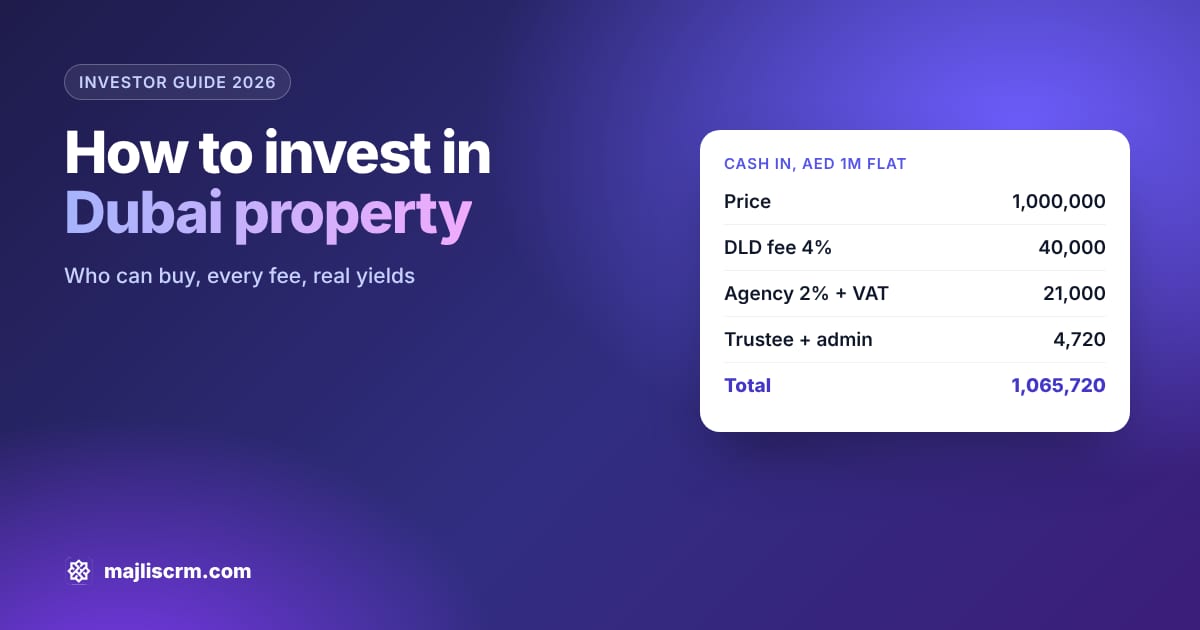
Quick answer: To invest in Dubai property, buy in a freehold area designated for foreigners, set a budget that adds about 7% to the price for fees, get a bank pre-approval if you need a mortgage (60% maximum loan on an investment property), choose ready or off-plan, sign the DLD's Form F with the seller, then transfer the title at a registration trustee.
Key takeaways
- Foreigners, resident or not, can own freehold property in the areas listed under Dubai's Regulation No. 3 of 2006 and later additions: Dubai Marina, Downtown, Business Bay, JVC, Dubai Hills and many more.
- The DLD transfer fee is 4% of the price. The DLD lists it as 2% from each side, but in practice the buyer usually pays all of it, so check what Form F says.
- The Central Bank caps a mortgage on a second or investment property at 60% of value for expatriates, and at 50% on any off-plan purchase.
- Asking-price yields in H1 2026 ranged from about 3% to 7%: JVC 7.00%, Dubai Marina 5.53%, Palm Jumeirah apartments 3.91% (dubizzle data). After costs and vacancy, expect 2 to 3 points less.
- There is no annual property tax and no income tax on rent for an individual who needs no licence to let the property. Agency fees carry 5% VAT.
- Prices and rents fell in Q2 2026 as new supply arrived, so buy on numbers that still work if rents soften.
Last checked: 30 October 2026.
This is a complete guide to how to invest in Dubai property in 2026, written for investors and for the agents who advise them. It covers who can buy, the process step by step, every fee with its official source, rental yields by area, the Golden Visa threshold, tax, the risks, and a worked example in AED of what a JVC apartment really earns once the costs are in.
For where prices may go next, read our Dubai real estate market 2026 forecast. This post is about the mechanics: how the money moves, what it costs and what comes back.
Can foreigners buy property in Dubai?
Yes. Foreigners can buy property in Dubai whether or not they live in the UAE, but outside a few nationalities they can only buy in designated areas.
The legal basis is Law No. 7 of 2006 on real estate registration, which lets non-UAE nationals own freehold land and property in areas the Ruler of Dubai designates. Those areas are listed in Regulation No. 3 of 2006 Determining Areas for Ownership by Non-UAE Nationals of Real Property in the Emirate of Dubai. Article 3 of that regulation says non-UAE nationals "may acquire freehold ownership rights over Real Property without time restriction" on the listed plots, or usufruct and leasehold rights of up to 99 years. The list has been extended since, for example by Resolution No. 25 of 2021.
Freehold is ownership of the unit, and its share of the land, with no end date. You can sell it, let it, mortgage it and leave it to your heirs.
The designated areas cover almost every place an investor will look at: Dubai Marina, JBR, JLT, Downtown Dubai, Business Bay, Palm Jumeirah, Emirates Hills, Arabian Ranches, Jumeirah Village (JVC and JVT), Dubai Sports City, Motor City, International City, Discovery Gardens and Dubai Investments Park, among others (Khaleej Times, citing the DLD list, July 2024). UAE and GCC nationals can own anywhere in the emirate.
Rule: If a unit is not in a designated area, a foreign buyer cannot take freehold title to it. A licensed agent or the DLD can confirm a specific plot before you pay anything.
How to invest in Dubai property, step by step
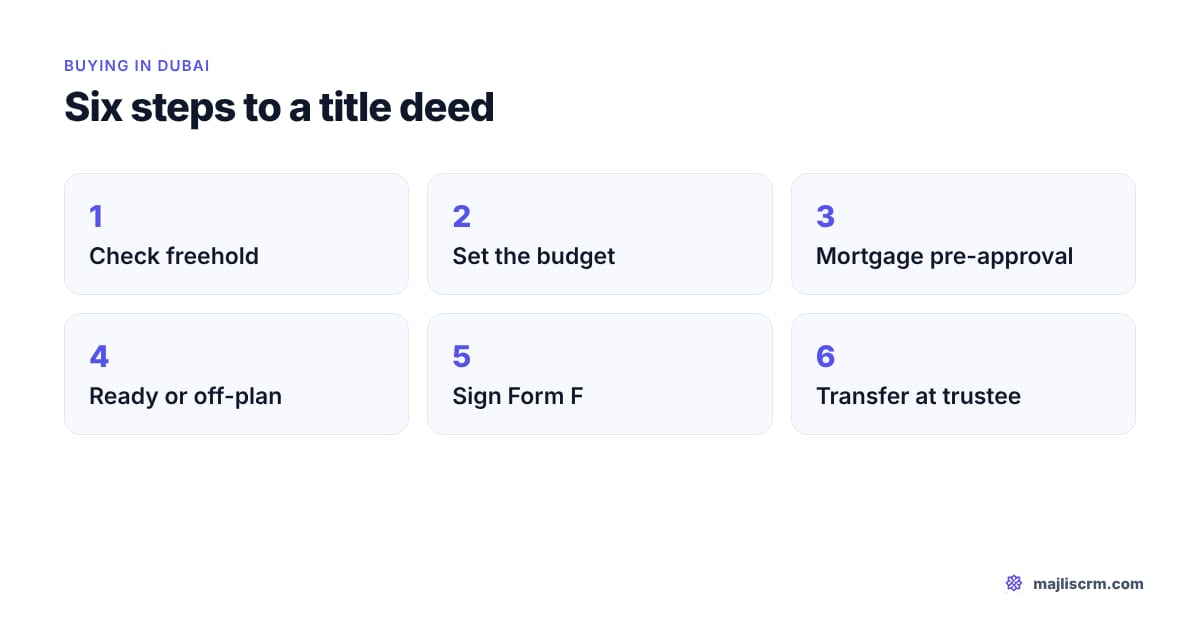
Here is the whole path for a resale purchase, from first budget to title deed. Off-plan is different at steps 4 to 6, covered in the next section.
| Step | What happens | Who is involved |
|---|---|---|
| 1. Set the budget | Price plus about 7% in fees for a cash buyer, more with a mortgage | You |
| 2. Mortgage pre-approval | A UAE bank confirms how much it will lend, before you make an offer | Bank or mortgage adviser |
| 3. Choose the unit | Ready or off-plan, area, yield, service charges, developer track record | You and a RERA-licensed agent (Form B with your agent) |
| 4. Sign Form F | The DLD's standard sale contract between buyer and seller, with price, deposit and dates | Buyer, seller, agents |
| 5. Developer NOC | The developer confirms no service charges are owed and issues an e-NOC | Seller and developer |
| 6. Transfer | Fees paid, title deed issued in your name at a registration trustee | Buyer, seller, bank, trustee |
Step 1: Set the full budget, not just the price
The price on the listing is not what you pay. A cash buyer of a AED 1 million resale apartment pays about AED 1.066 million once the DLD fee, the admin fees, the trustee and the agency commission are added (the full table is below). A mortgage adds the bank's valuation, arrangement and registration fees on top.
Step 2: Get a mortgage pre-approval, and know the Central Bank caps
The Central Bank of the UAE sets the maximum loan-to-value (LTV) in its Regulations regarding Mortgage Loans (Circular No. 31/2013), last amended by Board Resolution No. 31/2/2020, which raised first-time buyer limits by 5 points with effect from 8 April 2020.
| Expatriate buyer, as of October 2026 | Maximum loan | Minimum equity |
|---|---|---|
| First home, owner occupier, value AED 5 million or less | 80% | 20% |
| First home, owner occupier, value over AED 5 million | 70% | 30% |
| Second home or investment property, any value | 60% | 40% |
| Off-plan, any purpose, any buyer | 50% | 50% |
The line most investors miss is the third one: a buy-to-let is an investment property, so 60% is the ceiling even if it is the first property you buy in Dubai. The same regulation sets a maximum tenor of 25 years, a debt burden ratio of no more than 50% of income, a stress test at 2 to 4 percentage points above the loan rate, and, for an investment property, a deduction of at least two months' rent from the income the bank counts. Expatriates can borrow up to 7 years' annual income.
Non-residents: the Central Bank's caps do not set separate limits for buyers who live outside the UAE. Each bank decides whether it lends to non-residents at all, to which nationalities and how much, and those internal limits are often below the caps. Treat the table as a ceiling and get a written pre-approval before you sign Form F, because a deal that falls through for lack of finance can cost you the deposit.
Step 3: Choose the unit
Compare units on net yield, not asking price. Look up the building's service charge on the DLD's Service Charge Index, check recent sales and rents in the building, and ask how long similar units sit empty. Your agent will ask you to sign Form B, the DLD's standard buyer and broker agreement.
Step 4: Sign Form F
Form F is the DLD's standard sale contract between buyer and seller, often still called the MOU. Since 1 May 2014, every sale and purchase in Dubai has to be documented on the DLD's standard forms: Form A (seller and broker), Form B (buyer and broker) and Form F (buyer and seller), according to Al Tamimi & Company. Form F records the price, the deposit, who pays which fees and the transfer date. Read the fee clause: it is where the 4% is allocated.
Steps 5 and 6: Developer NOC and transfer
For a freehold unit, the seller gets the developer's no-objection e-certificate (e-NOC) through the Dubai REST app. The transfer then happens at a Real Estate Registration Trustee service centre. Documents are checked, the fees are paid, and the title deed is issued in your name. Non-resident buyers can use a passport where residents use an Emirates ID (DLD, Property Sale Registration service page). If there is a mortgage on either side, the banks attend to clear the seller's loan and register yours.
Should you buy ready or off-plan in Dubai?
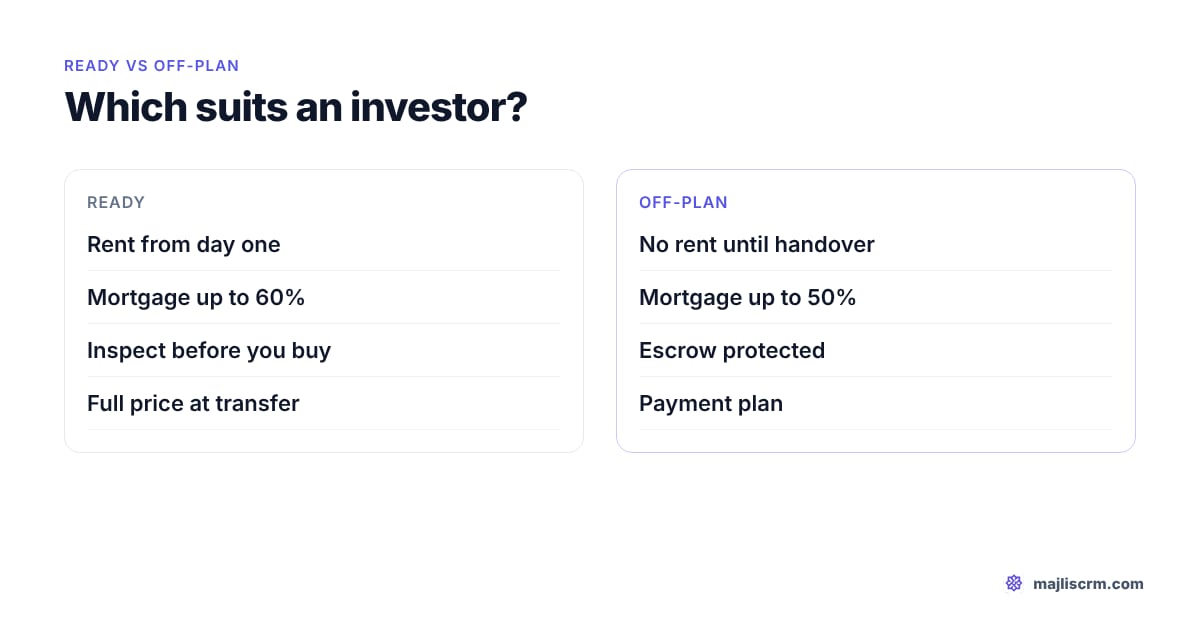
Ready property earns rent from the first month. Off-plan is bought from the developer before completion, usually on a payment plan, and earns nothing until handover.
| Ready (resale) | Off-plan | |
|---|---|---|
| Income | Rent from the first tenancy | None until handover |
| Payment | Full price at transfer (cash or mortgage) | Instalments to the developer during construction |
| Maximum mortgage (expatriate investor) | 60% | 50% |
| DLD fee | 4% at transfer | 4%, registered on the interim register; some developers pay part as an incentive |
| Buyer protection | You can inspect what you buy | Payments go to a project escrow account (Law No. 8 of 2007) |
| Main risk | Overpaying, high service charges, older building | Delay, finish quality, supply arriving at handover |
Off-plan buyers in Dubai are protected by Law No. 8 of 2007 Concerning Escrow Accounts for Real Estate Development, which requires buyers' payments to go into an escrow account for the project, and by Law No. 13 of 2008 Regulating the Interim Property Register, under which off-plan sales are registered with the DLD before completion. The DLD's initial sale page lists the registration fee as 2% from each party, the same 4% total as a resale. Our off-plan property guide covers payment plans, escrow and handover in detail, and our list of the best real estate developers in Dubai sets out how to judge a developer's delivery record.
A third route is buying below market. Our guide to distress deals in Dubai explains what a genuine distress sale looks like and how to check one.
How much does it cost to buy property in Dubai?
For a cash buyer, budget roughly 6.5% to 7% of the price on top of the price itself. Here is each fee and where it comes from.
| Cost | Amount | Source |
|---|---|---|
| DLD transfer fee | 4% of the price (listed as 2% seller, 2% buyer; usually paid in full by the buyer by agreement) | DLD, October 2026 |
| Title deed issuance | AED 250 | DLD |
| Map fee (villas and apartments) | AED 250 | DLD |
| Knowledge and innovation fees | AED 10 each | DLD |
| Registration trustee fee | AED 4,000 + VAT (price AED 500,000 or more); AED 2,000 + VAT below that | DLD |
| Agency commission | Agreed in Form B; around 2% + 5% VAT is the common rate | Bayut, October 2026 |
| Mortgage registration | 0.25% of the loan + admin of about AED 290 | DLD; Bayut |
| Bank arrangement fee | Around 0.5% to 1% of the loan + VAT | Bayut, October 2026 |
| Bank valuation | Around AED 2,500 to 3,500 + VAT | Bayut, October 2026 |
| Service charges (yearly) | Per square foot, set per building | DLD Service Charge Index |
The 4% is fixed. Who pays it is a contract term: Dubai's fee legislation says the fee is shared equally between seller and buyer unless they agree otherwise, and the DLD's service page lists 2% each. In the resale market the seller's price usually assumes the buyer pays all 4%, so read Form F before you sign. For how agency commission works and who pays it, see our guide to real estate commission in Dubai.
What rental yield can you expect in Dubai?
Gross rental yield is the year's rent divided by the price. Net yield is what is left after service charges, maintenance, letting fees and empty months, divided by everything you paid, fees included.
The figures below are dubizzle's projected returns for H1 2026 (January to June), based on activity on its platform, which reflects asking prices rather than every recorded transaction. Treat them as gross.
| Area | Type | Projected yield, H1 2026 | Average price per sq ft |
|---|---|---|---|
| International City | Apartments | 7.10% | AED 1,116 |
| Jumeirah Village Circle (JVC) | Apartments | 7.00% | AED 1,497 |
| Arjan | Apartments | 6.79% | AED 1,585 |
| Dubai Silicon Oasis | Apartments | 6.66% | AED 1,339 |
| Dubai Hills Estate | Apartments | 6.42% | AED 2,469 |
| DAMAC Lagoons | Villas | 6.23% | AED 1,565 |
| Business Bay | Apartments | 5.54% | AED 2,408 |
| Dubai Marina | Apartments | 5.53% | AED 2,220 |
| Downtown Dubai | Apartments | 5.17% | AED 3,255 |
| Dubai Hills Estate | Villas | 4.33% | AED 2,825 |
| Palm Jumeirah | Apartments | 3.91% | AED 4,036 |
| Arabian Ranches | Villas | 3.83% | AED 2,154 |
The pattern is consistent across sources: cheaper, mid-market apartments yield more; prime villas yield less and are bought more for capital growth and lifestyle. A Kuwait Financial Centre (Markaz) outlook reported by Khaleej Times in February 2026 put Dubai's average residential yield at 6% to 8% for 2026.
Watch out: rents are not fully in your control. Increases on renewal are limited by the DLD's rental index (see our guide to the Dubai rental index and rent increases), and Cushman & Wakefield data showed average rents down 6% quarter on quarter in Q2 2026 (Khaleej Times, August 2026). Model your yield on today's rent for the building, not last year's peak.
Worked example: what a JVC apartment really earns
Take a one-bedroom apartment in JVC bought for AED 1,000,000 in cash, about 750 sq ft, let at AED 70,000 a year (a 7.00% gross yield, in line with the H1 2026 JVC figure). The buyer pays the full DLD fee.
| Purchase | AED |
|---|---|
| Price | 1,000,000 |
| DLD transfer fee (4%) | 40,000 |
| DLD admin (title deed 250, map 250, knowledge 10, innovation 10) | 520 |
| Registration trustee (4,000 + 5% VAT) | 4,200 |
| Agency commission (2% + 5% VAT) | 21,000 |
| Total cash in | 1,065,720 |
| First year | AED |
|---|---|
| Rent | 70,000 |
| Service charges (assumed AED 15 per sq ft x 750) | minus 11,250 |
| Maintenance and insurance allowance (assumed) | minus 2,000 |
| Letting fee to find a tenant (assumed 5% of rent) | minus 3,500 |
| One month empty between tenants (assumed) | minus 5,833 |
| Net income | 47,417 |
| Net yield on cash in (47,417 / 1,065,720) | 4.45% |
A 7% gross yield becomes about 4.5% net in year one. From year two the purchase costs are already paid, but they stay in the denominator until you sell, which is why holding period matters: the AED 65,720 in fees is roughly 1.4 years of net rent.
With a mortgage at the 60% investment cap, the same purchase needs AED 400,000 in equity, the AED 65,720 in fees, and mortgage registration of AED 1,790 (0.25% of AED 600,000 plus AED 290): about AED 467,510 before the bank's own valuation and arrangement fees. The interest then comes out of the AED 47,417. Ask the bank for the rate and run the numbers before assuming leverage helps.
Rule: The assumed lines (service charge, maintenance, letting fee, vacancy) are illustrations. Replace them with the building's figure from the DLD Service Charge Index and a real quote from a property manager.
Does buying property in Dubai get you a Golden Visa?
Yes, at AED 2 million. The DLD's Golden Visa service for investors issues a 10-year renewable residence permit for a property valued at AED 2 million or more, wholly owned by the applicant in their name. The property may be mortgaged, with a no-objection letter from the bank showing the amount paid and the balance. The applicant must be inside the UAE to apply. The DLD lists the total cost of the 10-year permit at AED 9,884.75 (October 2026), with family members added on top.
Note that the federal u.ae portal currently lists real estate investment residency at 5 years, so confirm the term at the time you apply. Off-plan rules, joint ownership and the AED 2 million paid-up question are covered in our Golden Visa through property guide.
Do you pay tax on property in Dubai?
Less than almost anywhere else, but not nothing.
- No annual property tax. Dubai charges the one-off 4% transfer fee and yearly service charges, but there is no recurring tax on owning property.
- Corporate tax: under Cabinet Decision No. 49 of 2023, an individual's income from real estate investment (selling, leasing or renting property in the UAE) is excluded from corporate tax, whatever the amount, as long as the activity is not carried out through, and does not require, a licence. The Federal Tax Authority published a guide on Real Estate Investment for Natural Persons on 24 October 2024. Holiday home letting that needs a permit from Dubai's Department of Economy and Tourism falls outside the exclusion, according to Hadef & Partners. Owning through a company is taxed differently: take advice.
- VAT: supplies of residential property are generally exempt; the first supply of a residential building within three years of completion is zero-rated; commercial property sales and leases are taxed at 5% (UAE Ministry of Finance). Agency commission, trustee fees and bank fees carry 5% VAT.
- Your home country: UAE rules do not decide what your own country taxes. Check how your residence country treats foreign rent and gains.
What are the risks of investing in Dubai property?
- Supply. In May 2025 Fitch expected a correction of up to 15% in late 2025 or 2026, with supply rising 16% against population growth of about 5% (Khaleej Times, May 2025). Cushman & Wakefield data showed sale prices down 4% and rents down 6% quarter on quarter in Q2 2026, with about 32,000 more units due in the second half of the year (Khaleej Times, August 2026).
- Leverage. A 60% loan magnifies a price fall. If prices drop 15%, an investor with 40% equity loses more than a third of it on paper.
- Off-plan delay. No rent until handover, and a handover that lands in a wave of completions competes with thousands of similar units for tenants.
- Service charges. They differ widely by building and can turn a good gross yield into a poor net one.
- Liquidity. Selling takes weeks and costs agency commission again. Property is not cash.
- Currency. The dirham is pegged to the US dollar. An investor earning in another currency carries exchange rate risk on the rent and the sale.
These are reasons to buy at a price where the net yield still works if rents fall 10%, and to keep cash for a few empty months.
How should agents guide investor clients?
Investors buy numbers. The agents who win repeat business from them are the ones who bring the numbers first.
- Lead with net yield. Send the worked example above with the unit's real service charge, a realistic rent and a vacancy month. A client who sees 4.5% net from you will trust you more than one promised 7% by someone else.
- Qualify finance on the first call. Resident or non-resident, cash or mortgage, first home or investment. The 60% cap on an investment property surprises many buyers late in the deal.
- Explain the 4%. Tell buyers early that Form F decides who pays it, and put the total cash needed in writing.
- Flag the Golden Visa line. If a client is close to AED 2 million, say so. It changes what they buy.
- Stay compliant. Every listing you advertise needs a DLD permit, and your client should only ever deal with a RERA-licensed agent. See our guides to the advertising permit and Dubai real estate laws in 2026.
- Follow up on a schedule. Investors compare for months and come back when a number moves. Keep their criteria, budget and every conversation on the lead, so whoever answers next knows the whole story.
That last point is where a CRM earns its keep. In Majlis, the client's WhatsApp chat sits beside their lead, the AI suggests follow-ups after each note or call for the agent to accept, and property matching shows which listings fit an investor's budget and areas.
Frequently asked questions
Can I buy property in Dubai without living in the UAE?
Yes. Non-residents can buy freehold property in Dubai's designated areas, and the DLD accepts a passport in place of an Emirates ID at transfer. Getting a mortgage is harder: each bank sets its own rules for non-residents, so get a written pre-approval first.
How much money do I need to invest in Dubai property?
There is no legal minimum. A cash buyer needs the price plus roughly 6.5% to 7% for fees; on a AED 1 million apartment that is about AED 1.066 million. With a mortgage on an investment property you need at least 40% of the price plus fees, because the Central Bank caps the loan at 60%.
What is the DLD fee in Dubai?
The DLD transfer fee is 4% of the sale price, plus small admin fees (AED 250 title deed, AED 250 map fee for villas and apartments, AED 10 knowledge and AED 10 innovation fees) and the trustee fee of AED 4,000 + VAT for deals of AED 500,000 or more. The DLD lists the 4% as 2% each for seller and buyer, but the buyer usually pays it all by agreement.
Which area in Dubai has the highest rental yield?
In dubizzle's H1 2026 data, affordable and mid-market apartment areas led: International City at 7.10%, JVC at 7.00% and Arjan at 6.79%. Prime areas yield less, such as Palm Jumeirah apartments at 3.91%. These are gross figures based on asking prices; net yields are lower.
Is rental income in Dubai taxed?
For an individual, income from renting UAE property is excluded from corporate tax under Cabinet Decision No. 49 of 2023, provided the activity does not need a licence. Holiday home lets that require a permit fall outside that exclusion. Your home country may still tax the income.
Is off-plan or ready property better for investors?
Ready property earns rent straight away and can be mortgaged up to 60% for an investor. Off-plan spreads payments over construction and is protected by escrow under Law No. 8 of 2007, but earns nothing until handover and is capped at a 50% mortgage. Choose by whether you need income now or can wait.
This is general information, not legal, tax or financial advice. Fees, lending rules and visa conditions change; confirm them with the DLD, your bank and a qualified adviser before you buy.
If you are an agent or brokerage owner advising investors, Majlis CRM keeps every enquiry from Property Finder, Bayut, Dubizzle, WhatsApp and your ads in one pipeline, routes each lead to an agent before it goes cold, and lets managers see every conversation on company numbers. Every feature is in every plan, with a 14-day free trial. Book a demo to see it with your own listings.
Sources
- Regulation No. (3) of 2006 Determining Areas for Ownership by Non-UAE Nationals of Real Property in the Emirate of Dubai, Dubai Legal Portal.
- Resolution No. (25) of 2021 Adding Land to the Areas for Ownership by Non-UAE Nationals, Dubai Legal Portal.
- How foreigners can buy property in Dubai; here's what you need to know, Khaleej Times, July 2024 (updated August 2024).
- Property Sale Registration, Dubai Land Department, checked October 2026.
- Request to register the initial sale, Dubai Land Department, checked October 2026.
- Mortgage registration application, Dubai Land Department, checked October 2026.
- Dubai Real Estate Legislation (fee schedule), Dubai Land Department.
- Service Charge Index, Dubai Land Department.
- Regulations regarding Mortgage Loans, Article (3): Important Ratios (Circular No. 31/2013), Central Bank of the UAE Rulebook.
- Amendments to Circular No. 31/2013 on Regulations regarding Mortgage Loans (Board Resolution No. 31/2/2020, effective 8 April 2020), Central Bank of the UAE Rulebook.
- Dubai Land Department introduces Mandatory Property Contracts, Al Tamimi & Company, July 2014.
- Law No. (8) of 2007 Concerning Escrow Accounts for Real Estate Development in the Emirate of Dubai, Dubai Legal Portal.
- Law No. (13) of 2008 Regulating the Interim Property Register in the Emirate of Dubai, Dubai Legal Portal.
- Total cost of buying property in Dubai: Every fee explained, Bayut, updated 20 October 2026.
- dubizzle's Market Report H1 2026: Dubai's Property Sales Market, dubizzle, 2026.
- Dubai yields stay among world's highest as GCC property surge rolls into 2026, Khaleej Times, 16 February 2026.
- Dubai home prices, rents decline as supply rises, 32,000 more units due this year, Khaleej Times, 9 August 2026.
- Dubai property prices could drop up to 15% as they hit peak, report says, Khaleej Times, 29 May 2025.
- Golden Visa application: Investor, Dubai Land Department, checked October 2026.
- Golden visa, UAE Government portal, updated 28 July 2026.
- Federal Tax Authority releases Guide on Real Estate Investment for Natural Persons, Hadef & Partners, November 2024.
- Value Added Tax, UAE Ministry of Finance.