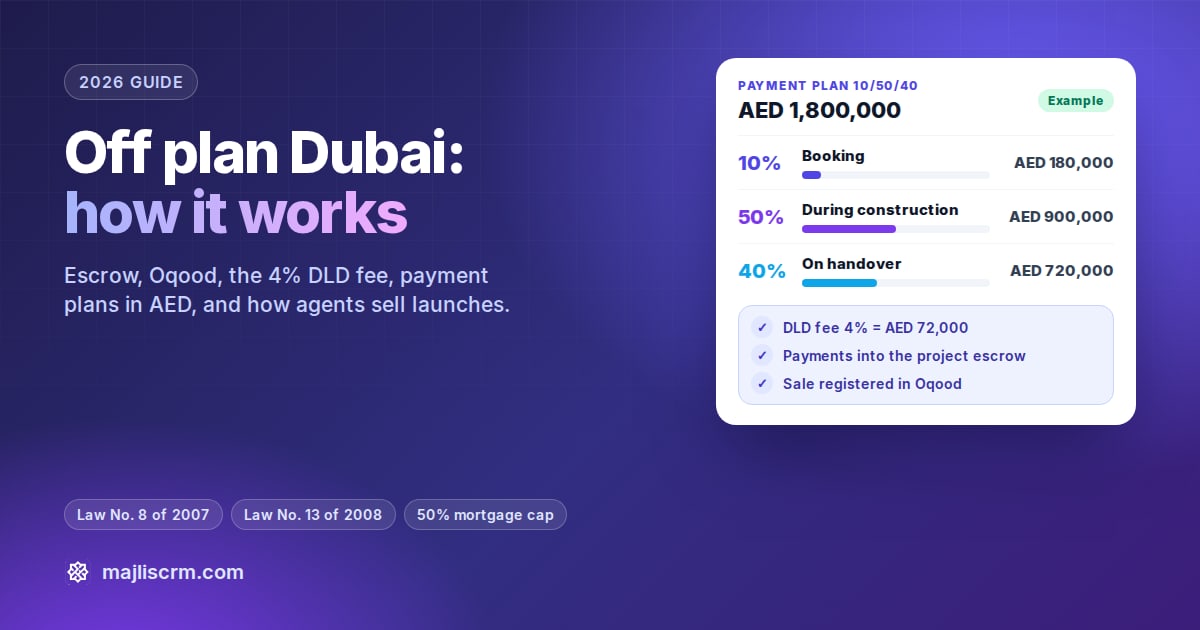
Quick answer: Buying off plan in Dubai means buying a unit before it is built and paying in instalments. Buyer money goes into an escrow account held for that one project under Law No. 8 of 2007. The sale is recorded in the DLD's interim register, called Oqood. The DLD fee is 4% of the price.
Off plan Dubai property is most of the market: roughly seven in ten homes sold in the first half of 2026 were not built yet. This guide covers what off plan means, the protections, checking a project, payment plans in AED, handover, resale, mortgages and defaults. The second half is for agents: launches, EOIs, leads, commissions and the paperwork before you advertise.
Key takeaways
- An off-plan unit is sold before it is finished. The developer must register the project, open an escrow account and post a 30% guarantee with the DLD before selling.
- Every off-plan sale has to be entered in the Interim Real Property Register (Oqood). Under Law No. 13 of 2008, a sale that is not registered has no effect.
- The DLD's published fee is 4% of the sale value, listed as 2% from the seller and 2% from the buyer. Most off-plan contracts pass the full 4% to the buyer, so check the SPA.
- Banks may lend at most 50% of an off-plan property's value under the Central Bank's mortgage rules, so most buyers pay the construction instalments themselves.
- If a buyer stops paying, Article 11 of Law No. 13 of 2008 (as amended in 2017) sets how much the developer may keep, from 25% to 40% of the unit's value depending on how far construction has got.
- Agents can only market projects the authorities have approved, and the developer must register its brokerage agreement with the DLD.
Last checked: 12 October 2026.
What does off plan mean in Dubai?
Off plan is a property sold by a developer before construction is complete, often before it has started, and paid for in instalments linked to dates or to construction progress. The buyer signs a Sale and Purchase Agreement (SPA) with the developer, pays a booking amount, and owns a registered contract right to the unit until it is finished and the title deed is issued.
In short, the off plan Dubai meaning is: you buy from the developer, you pay in stages, and your ownership sits in the DLD's interim register until handover, when it becomes a title deed. A unit resold by its first buyer before handover is still off plan (an off-plan resale, or assignment).
How big is off plan in Dubai's market?
Every research house counts it slightly differently, but all of them show the same thing: most homes sold in Dubai have not been built yet.
| Period | Off-plan share | Measure | Source |
|---|---|---|---|
| Full year 2025 | 65% of transactions, 53% of value | Residential sales | betterhomes full-year 2025 report |
| November 2025 | 70% | Residential sales transactions | betterhomes, reported by Khaleej Times (December 2025) |
| H1 2026 | 71.3% (of 80,509 sales worth AED 226.5 billion) | Residential sales | Engel & Völkers H1 2026 report |
| June 2026 | 76% (9,442 transactions) | Residential sales | Cavendish Maxwell data, reported by Gulf News (July 2026) |
The gap comes from method. "Two thirds to three quarters of Dubai home sales are off plan" is accurate for 2025 and 2026. For the wider picture, see our Dubai real estate market 2026 forecast.
What protects off plan buyers in Dubai?
Dubai has had specific off-plan laws since 2007. These are the ones that matter in practice.
Escrow under Law No. 8 of 2007
An escrow account is a bank account opened for one project, held by an escrow agent, into which buyers' payments go and from which money can only be used to build that project. Law No. 8 of 2007 says:
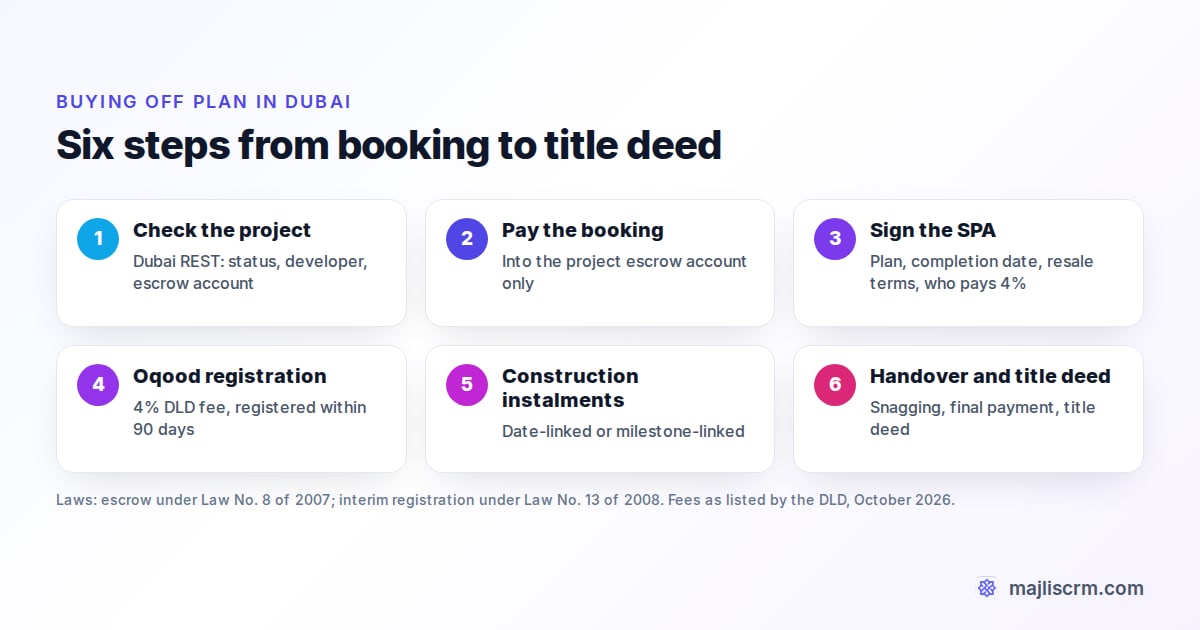
- A developer who wants to sell off plan must apply to the DLD to open an escrow account (Article 6), with the land's title deed attached.
- Payments from off-plan buyers, and from the project's financiers, are deposited into it (Article 7).
- The account is dedicated to building that project only, each project needs its own account, and creditors of the developer cannot attach the money in it (Article 9).
- After the completion certificate, the escrow agent keeps back 5% of the account, released to the developer one year after the units are registered in buyers' names (Article 14).
- If a project stalls, the escrow agent must, after consulting the DLD, act to protect depositors, by completing the project or refunding them (Article 15).
- A developer may not advertise off-plan units without written authorisation from the DLD (Article 5).
Rule: Pay off-plan instalments only into the project's escrow account, never to a person, an agency or a developer's general account. The escrow account number appears on the project's fact sheet on Dubai REST.
Project registration and the 30% guarantee
Before selling, the developer registers the project with the DLD and opens the escrow account through its "Register Project" service. The DLD's requirements include freehold or long-lease land with an ownership deed, approved plans, final building permits, a no-objection letter from the master developer for the name, off-plan sale and marketing, and a 30% guarantee. The developer can meet the guarantee by completing 30% of construction, giving a bank guarantee for 30% of construction, or depositing 30% in cash. The registration fee is AED 150,000 plus AED 20 in knowledge and innovation fees.
Interim registration (Oqood) under Law No. 13 of 2008
Oqood is the DLD's system for registering off-plan sales in the Interim Real Property Register. Law No. 13 of 2008 makes registration essential. Under Article 3, a sale or other disposition of an off-plan unit that is not entered in the interim register has no effect. Article 10 makes any off-plan sale contract signed in a project before it is approved void, and it applies to brokers as well as developers.
The DLD's "Request to register the initial sale" service is filed by the developer through the Oqood portal. Its published fees, as of October 2026:
| Item | Amount |
|---|---|
| Registration fee, seller (developer) | 2% of the sale value |
| Registration fee, purchaser | 2% of the sale value |
| Knowledge fee | AED 10 |
| Innovation fee | AED 10 |
| Developer self-registration fee (Oqood portal) | AED 1,000 |
| Deadline | Registered within 90 days of signing |
That is the "4% DLD fee". The DLD lists it as 2% plus 2%, but the SPA decides who pays, and on most launches the buyer pays the full 4% to the developer around booking. Some launches waive or split it. Quote the SPA's figure, not "about 4%".
Watch out: Developers may not charge their own fees on a sale or resale of an off-plan unit, other than administrative costs the DLD approves (Law No. 13 of 2008, Article 7). If a client is quoted a large "transfer fee", ask what it is for.
Defects after handover under Law No. 6 of 2019
Under Article 40 of Law No. 6 of 2019 on jointly owned property, the developer is liable for structural defects for 10 years from the completion certificate, and for repairing or replacing defective installations (mechanical, electrical, sanitary and similar) for one year from handover of the unit to the owner. If the owner does not take possession, the one year runs from the completion certificate.
How do you check an off plan project in Dubai?
Do this before paying anything, including a booking deposit.
- Find the project on Dubai REST. The DLD's Dubai REST app has a Project Status section, also searchable on the DLD website by project name or number. The fact sheet shows the project's registration, start and completion dates, inspection details, the developer, the management company and the escrow account. The DLD says the app shows completion percentages and actual project photos for off-plan projects.
- Match the escrow account. The account in the SPA and on the payment instructions should be the project's escrow account on the fact sheet.
- Check the developer. The DLD publishes a list of licensed developers. Under Law No. 8 of 2007, nobody may develop and sell off plan without being registered and licensed (Article 4).
- Check the advertisement. Off-plan ads need a DLD permit, and the permit number belongs on the ad. Our guide to the Trakheesi advertising permit explains how to verify one.
- Read the SPA: completion date, grace period, remedies for delay, payment schedule, resale conditions and who pays the 4%.
A project you cannot find on Dubai REST is not ready to take your money, whatever the brochure says.
How do off plan payment plans work in Dubai?
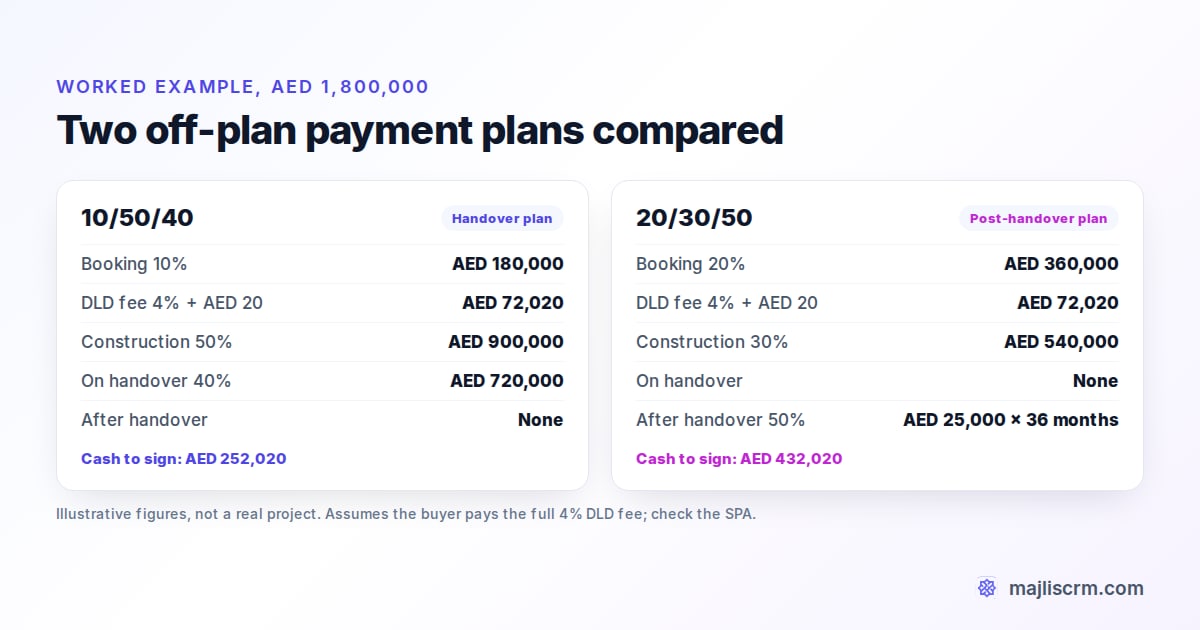
An off plan payment plan is the schedule in the SPA that says how much of the price is due, and when. Plans are written as percentages: 10/50/40 means 10% on booking, 50% during construction and 40% on handover. A post-handover payment plan moves part of the price to after you get the keys, paid monthly or quarterly over one to several years.
Here is a worked example on an AED 1,800,000 two-bedroom, with the buyer paying the full 4% DLD fee. These are illustrative figures, not a real project.
| Stage | Plan A: 10/50/40 (handover) | Plan B: 20/30/50 (post-handover) |
|---|---|---|
| Booking | 10% = AED 180,000 | 20% = AED 360,000 |
| DLD fee (4%) plus AED 20 | AED 72,020 | AED 72,020 |
| Cash needed to sign | AED 252,020 | AED 432,020 |
| During construction | 50% = AED 900,000 (e.g. five instalments of AED 180,000) | 30% = AED 540,000 (e.g. three instalments of AED 180,000) |
| On handover | 40% = AED 720,000 | None |
| After handover | None | 50% = AED 900,000 over 36 months = AED 25,000 a month |
| Total price | AED 1,800,000 | AED 1,800,000 |
Things to explain to a client with that table in front of them:
- Construction-linked or date-linked? Some instalments fall due at a construction milestone, others on fixed dates. Date-linked instalments are due even if the site is behind.
- The handover payment is the big one. On Plan A the buyer needs AED 720,000 at handover. Most buyers plan to fund that with a mortgage, which is only possible if they qualify at that point.
- Post-handover plans trade cash now for monthly payments later. Rent can cover part of the monthly amount, but is not guaranteed. Service charges start at handover too.
Can you get a mortgage on off plan property in Dubai?
Yes, but the limit is lower than for a ready home. Under the Central Bank's mortgage regulations, introduced in 2013, a mortgage on an off-plan property is capped at 50% of the property's value, against 60% to 80% for ready properties depending on the buyer and the property (The National, October 2013). Not every bank lends on every project, so the first question for the bank is whether it finances that development at all.
Many buyers pay the construction instalments themselves and mortgage the handover payment, once the home is complete. Get a pre-approval well before handover: if rates, income or the valuation change, the shortfall is the buyer's.
What happens at handover, and what is snagging?
When the building is finished, the developer gets a completion certificate and calls buyers to pay the handover amount and collect their keys. The steps:
- Handover notice. The developer confirms completion and the amounts due.
- Snagging inspection. Snagging is inspecting the finished unit for defects (cracks, leaks, uneven tiles, faulty sockets) and listing them for the developer to fix. Do it before signing the handover form, and keep photos.
- Payment and keys. The buyer pays what is due and takes possession.
- Title deed. The developer turns the interim registration into a title deed through the DLD's "complete the initial procedures" service. Where the registration fee was already paid, the DLD lists AED 250 for the title deed, AED 250 for the unit map and AED 20 in knowledge and innovation fees.
Remember the one-year clock for installation defects starts at handover. Problems found in the first year should go to the developer in writing.
Can you sell an off plan property before completion?
Yes. Article 6 of Law No. 13 of 2008 allows an off-plan unit registered in the interim register to be sold, mortgaged or otherwise disposed of. The resale must itself be registered with the DLD, or it has no effect.
- The developer's conditions apply. Most SPAs say the buyer must have paid a minimum share of the price before reselling, and the developer issues a no-objection certificate (NOC) once that is met. The share varies by developer and is written in the SPA, so read it rather than assuming.
- The new buyer takes over the payment plan. They pay the seller for what the seller has paid (plus or minus any premium) and continue the remaining instalments to escrow.
- Fees are limited. The developer may only charge DLD-approved administrative costs on a resale (Article 7).
Sellers abroad will find the steps for powers of attorney and remote signing in our guide to selling property in Dubai from abroad.
Off plan property in Dubai: pros and cons
| Pros | Cons |
|---|---|
| Smaller cash needed to start (booking plus 4%) | No rental income until handover |
| Payments spread over construction, sometimes after handover | Completion can be late; the SPA decides what happens then |
| New building, new fittings, developer liable for defects (10 years structural, 1 year installations) | The finished unit may differ from the brochure within what the SPA allows |
| Escrow, project registration and the 30% guarantee protect buyer money | Mortgage limited to 50% of value before completion |
| Can be resold before completion once the developer's conditions are met | Missing instalments can cost up to 40% of the unit's value |
What happens if an off plan buyer stops paying, or the project is cancelled?
Article 11 of Law No. 13 of 2008, as amended by Law No. 19 of 2017, sets the procedure when a buyer defaults. The developer notifies the DLD, the DLD gives the buyer 30 days' written notice (and may mediate), and if the buyer still does not pay, the DLD issues a document confirming the procedure and the project's completion percentage. What the developer may do then depends on that percentage:
| Project completion | Developer's options | Most the developer may keep |
|---|---|---|
| Over 80% | Keep the contract and claim the balance, ask the DLD to sell the unit at auction, or terminate | If terminated: 40% of the unit's value |
| 60% to 80% | Terminate | 40% of the unit's value |
| Under 60% (work started) | Terminate | 25% of the unit's value |
| Not started, for reasons outside the developer's control | Terminate | 30% of the amounts paid |
In the first three cases the balance goes back to the buyer within one year of termination or 60 days of the unit being resold, whichever comes first. In the last case, within 60 days.
Worked example: a buyer on the AED 1,800,000 unit has paid AED 540,000 (30%) and stops paying.
- If the project is 70% complete, the developer may keep up to 40% of AED 1,800,000, which is AED 720,000. That is more than the buyer paid, so the buyer can lose everything paid.
- If the project is 50% complete, the cap is 25%, AED 450,000, so at least AED 90,000 comes back.
That is the strongest argument for stress-testing a payment plan before booking.
When the regulator cancels a project by a reasoned decision, it is a different case: the developer must refund everything the buyers paid, under Law No. 8 of 2007. Delays without cancellation are governed by the SPA, so its completion date, grace period and remedies are worth reading line by line. For the wider legal framework, see Dubai real estate laws in 2026.
Buying off plan to qualify for a residence visa? The rules are in our golden visa property guide.
How do agents sell off plan property in Dubai?
In off-plan sales the stock, price list and payment plan are the developer's. The agency's job is to bring qualified buyers fast, mostly during a launch.
The marketing agreement and the advertising permit
Before an agency markets a project, it needs a brokerage agreement with the developer. Article 9 of Law No. 13 of 2008 requires the developer to register that contract with the DLD. Article 10 forbids brokers from entering off-plan sale contracts in projects that are not yet approved, and such contracts are void. The developer also needs written DLD authorisation to advertise off plan (Law No. 8 of 2007, Article 5), and each ad needs its permit. Our guide to the Trakheesi permit covers how agencies get one and what goes on the ad. Every agent on the deal also needs a valid RERA broker card.
Launches and EOIs
An EOI (expression of interest) is a refundable deposit or registration a buyer places through an agency before or at a launch, to be considered when units are allocated. EOIs are a market practice, not a DLD procedure. Amounts, refund terms and how allocation works are set by each developer, so get them in writing and explain them to the buyer before taking any money. An EOI is not a sale: the sale starts with the booking and the SPA, and is only effective once registered in Oqood.
Managing hundreds of launch leads at once
A launch campaign on Instagram, Facebook lead ads and the portals can bring in hundreds of enquiries in a day or two, with a short window before the best units are allocated. Converting them is mostly process:
- One pipeline for every source, tagged with the project, so nobody works from a spreadsheet export.
- Fast, even routing. Each lead gets an owner straight away. If that agent does not call within the agreed time, it moves to the next agent rather than going cold.
- Templates for the first reply. Brochure, floor plans and payment plan on WhatsApp in minutes, then qualify: budget, cash or mortgage, end use or investment, timeline.
- A stage per step: contacted, EOI paid, unit allocated, booking paid, SPA signed, Oqood registered.
Payment plan follow-ups
An off-plan client stays your client for years: instalments, handover, snagging, the handover mortgage and, later, resale or leasing. Put the instalment dates and handover month on the client's record as follow-ups, so the reminder comes from the agent, not the developer's collections team. Those clients come back for the next launch.
Developer commissions
On a direct off-plan sale the commission is normally paid by the developer to the agency under the brokerage agreement, not by the buyer, and rates, payment triggers and clawback terms vary by developer and project. Many developers pay only once the buyer has paid a set share and the sale is registered, so the agency often waits weeks or months for payment. Read how commission works across sale types in real estate commission in Dubai, and track each deal's commission status, not only the sale.
How Majlis CRM helps with off plan sales
Majlis CRM is a real estate CRM for Dubai brokerages. Facebook and Instagram lead ads, WhatsApp, Bayut, Dubizzle and Property Finder enquiries, website forms and ManyChat arrive in one pipeline. Lead rotation moves a lead to the next agent when nobody contacts it in time, and response times are tracked per agent. WhatsApp templates and bulk sends get the payment plan out fast, AI suggests follow-ups after each call or note, and a won lead becomes a deal with its commission tracked. Book a demo to see it on a launch pipeline.
Frequently asked questions
What does off plan mean in Dubai?
Off plan means buying a property from a developer before it is finished, often before construction starts, and paying in instalments. The sale is registered in the DLD's interim register (Oqood) and your money goes into the project's escrow account. You get a title deed after handover.
What is Oqood registration?
Oqood is the Dubai Land Department's system for registering off-plan sales in the Interim Real Property Register. The developer files it through the Oqood portal within 90 days of signing. Under Law No. 13 of 2008, an off-plan sale that is not registered has no effect.
How much is the DLD fee on off plan property?
The DLD lists 4% of the sale value (2% from the seller and 2% from the buyer) plus AED 20 in knowledge and innovation fees, as of October 2026. On most launches the SPA makes the buyer pay the full 4%, though some developers waive or share it. Check the SPA for the exact amount.
Is off plan property in Dubai safe?
It is regulated: buyer payments go into a project escrow account, the developer must register the project and post a 30% guarantee, and every sale is registered with the DLD. It still carries risk, mainly delay and the cost of defaulting on the payment plan. Check the project on Dubai REST and pay only into its escrow account.
Can I sell my off plan property before handover?
Yes, once the unit is registered in the interim register and you meet the developer's resale conditions, usually a minimum share of the price paid. The developer issues a NOC, the buyer takes over the remaining instalments, and the resale is registered with the DLD.
What happens if I stop paying for an off plan property?
The developer notifies the DLD, which gives you 30 days to pay. If you do not, the developer may terminate and keep up to 40% of the unit's value when the project is over 60% complete, or up to 25% when it is below 60%, and refund the rest.
This is general information, not legal or financial advice. Fees and rules change; check the current DLD fee schedule, the SPA and the law, or ask a qualified adviser, before buying or advising a client.
Sources
- Request to register the initial sale, Dubai Land Department (accessed October 2026)
- Request to complete the initial procedures data, Dubai Land Department (accessed October 2026)
- Register Project, Dubai Land Department (accessed October 2026)
- Project Status Enquiry, Dubai Land Department (accessed October 2026)
- Dubai Land Department enhances 'Dubai REST' real estate services via improved interactive interface, Dubai Land Department, 15 December 2023
- Law No. (8) of 2007 Concerning Escrow Accounts for Real Estate Development in the Emirate of Dubai, Dubai Legislation Portal
- Law No. (13) of 2008 Regulating the Interim Real Property Register in the Emirate of Dubai, Dubai Legislation Portal
- Explanatory Notes on Article (11) of Law No. (19) of 2017, Dubai Legislation Portal, 2018
- Law No. (6) of 2019 Concerning Ownership of Jointly Owned Real Property in the Emirate of Dubai, Dubai Legislation Portal
- Central Bank issues new rules on mortgage cap, The National, 29 October 2013
- Dubai records strongest residential year in 2025, nets $149bln in sales (betterhomes full-year 2025 report), Zawya / TradeArabia, 2026
- Off-plan sales dominate as Dubai realty charges into 2026, Khaleej Times, 11 December 2025
- Dubai Residential Property Market Report, H1 2026, Engel & Völkers, 2026
- Dubai homes record Dh221.3b sales in first half of 2026, Gulf News, 6 July 2026