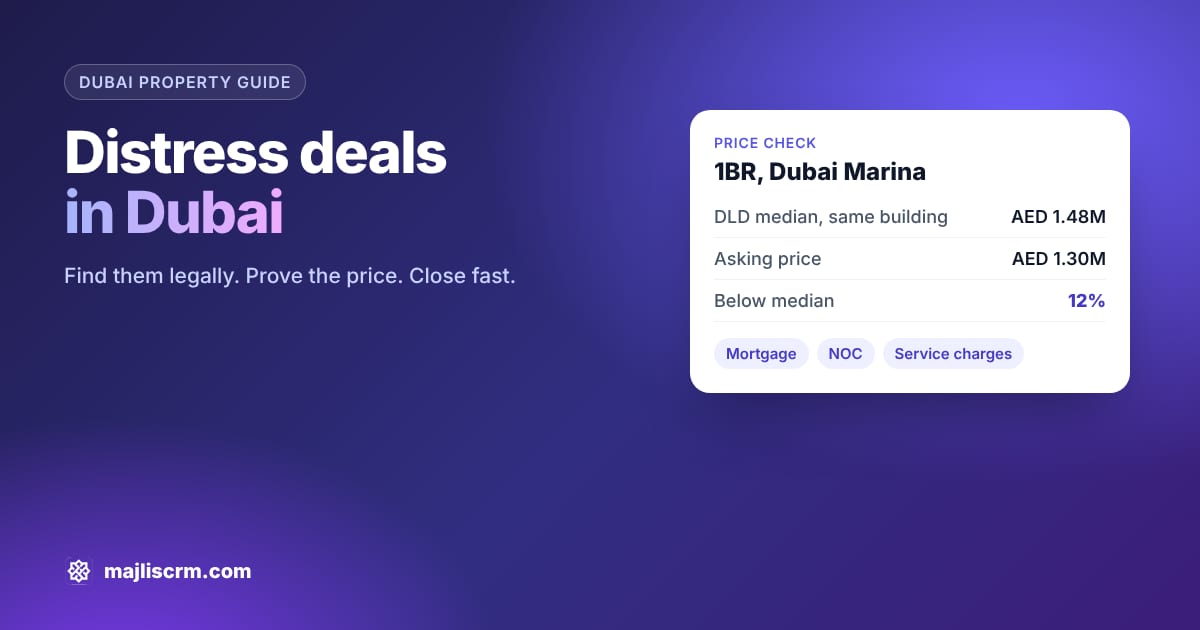
Quick answer: A distress deal in Dubai is a property sold below recent market value because the seller must sell fast: a mortgage they can no longer carry, an off-plan instalment they cannot pay, a move abroad or a court-ordered sale. A genuine one is proved against Dubai Land Department transaction data, not the listing's own claim, and checked for mortgage, service charges and developer NOC before anyone pays.
Key takeaways
- "Distress deal" is a marketing phrase, not a legal category. Most are motivated sellers, a few are forced sales (bank repossessions and court auctions).
- Prove the discount against DLD's own transaction records for the same building and size, from the last few months, before you call anything a distress price.
- A mortgaged unit can be sold: DLD's procedure pays the bank first by manager's cheque, then the seller, and title moves once the bank releases the mortgage.
- An off-plan assignment needs the developer's NOC, and most developers only give one after a set share of the price is paid (commonly 30 to 40%, set in the sale contract).
- Sourcing distress leads by phone is regulated: calls from a company number, 9am to 6pm, no calls to numbers on the Do Not Call Registry, with fines up to AED 150,000.
- Speed wins these deals. Agents who already hold a verified buyer list, and answer within minutes, close them.
Last checked: 30 October 2026.
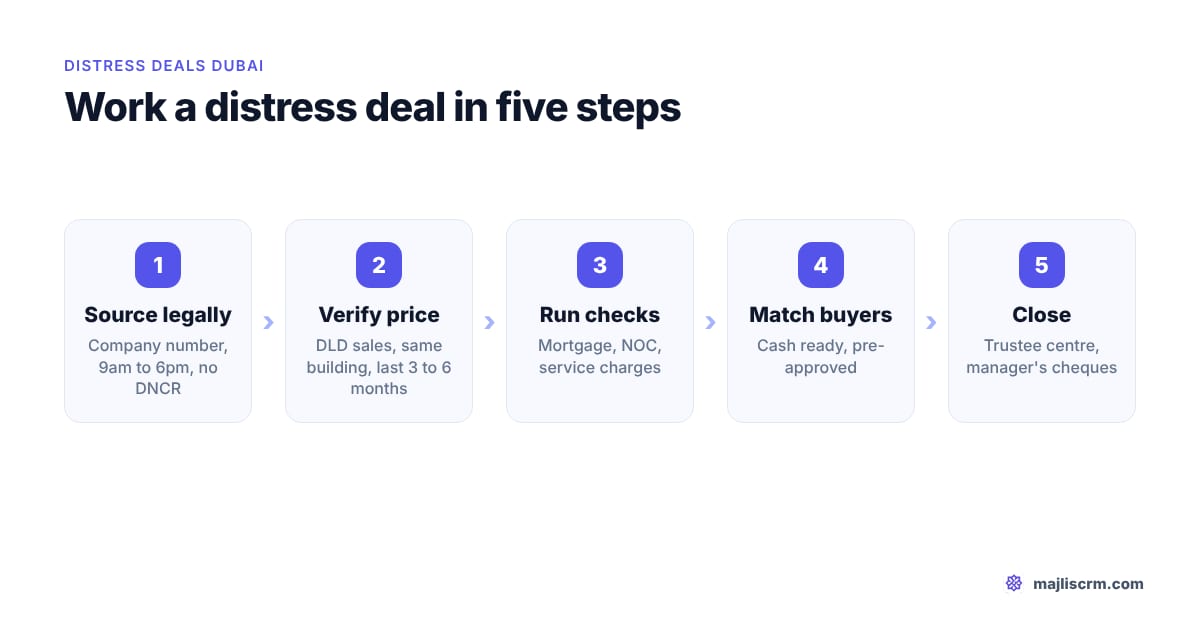
Search for distress deals in Dubai and you will find hundreds of listings with the word in the title. Some are real bargains; many are priced at market and labelled "distress" for clicks. This guide shows agents and investors how to tell them apart, source distress leads legally and close them fast.
What is a distress deal in Dubai?
A distress deal is a property sale where the seller accepts a price below recent comparable sales because time matters more to them than the last dirham. The property itself is usually fine. The pressure is on the owner.
A distress lead is a seller (or the agent of a seller) who has a reason to sell quickly and is open to pricing below market to do it. A distressed property is the unit being sold under that pressure. People use the three phrases interchangeably, and none of them is defined in Dubai law.
It helps to separate two kinds:
- Motivated sale: the owner chooses to sell fast. Relocating abroad, a job loss, a divorce, a business that needs cash, or an investor rebalancing. The owner still controls the sale and can say no.
- Forced sale: someone else sells. A bank enforcing a mortgage through the courts, or a court-ordered sale run as a public auction. The owner has lost control of the price.
Most "distress" listings on the portals are the first kind: a motivated seller can walk away from a low offer, while a forced sale follows a fixed process and timeline.
Why do sellers in Dubai sell below market?
These are the situations that produce genuine distress deals in Dubai. Each one leaves a trail you can check.
| Reason | What the pressure looks like | What to ask for |
|---|---|---|
| Mortgage pressure | Payments the owner can no longer carry, or a rate reset | Bank liability letter showing the amount owed |
| Off-plan payment due | A large instalment or handover payment the buyer cannot fund | Developer statement of account and payment plan |
| Relocation | Owner leaving the UAE on a fixed date | A realistic completion date and a power of attorney if they leave first |
| Cash need | Business, family or debt obligations | Clear title and the seller's own ID on the deed |
| Court or bank enforcement | A judge orders the sale after a mortgage default | The auction terms and the official valuation |
Market cycles add to the supply. Khaleej Times, reporting Betterhomes' quarterly review in July 2026, said Dubai recorded about 34,800 transactions in Q2 2026, down 31% year on year, and that average values slipped from about AED 1,850 to AED 1,688 per sq ft by the end of the quarter, roughly 7%. The same report quoted Betterhomes' CEO saying buyers were not panic selling. In other words, there are more motivated sellers than a year ago, but not a wave of forced ones. For the wider picture, see our Dubai real estate market 2026 forecast.
Where do distress deals in Dubai come from?
Your own owner database
The best distress leads are owners who already know you: past buyers, landlords you manage for, and earlier sellers. They call you first when life changes.
The portals
Property Finder, Bayut and Dubizzle carry many listings with "distress" or "below original price" in the title. Treat the word as a claim to test, not a fact. Price reductions on a listing that has been live for weeks are a better signal than the word itself.
Off-plan resales and assignments
An off-plan assignment is a sale where the original buyer transfers their contract with the developer to a new buyer before handover. Off-plan made up more than three quarters of Q2 2026 transactions, according to the same Betterhomes data, so instalment pressure is a large source of motivated sellers. Our off-plan property guide explains payment plans and handover in detail.
Bank repossessions and court auctions
When a borrower defaults, Dubai's mortgage law (Law No. 14 of 2008) sets the path. The lender gives at least 30 days' notice through a notary public (Article 25), then asks the enforcement judge to order the sale at public auction (Article 26). The borrower can ask for one delay of up to 60 days (Article 27), as Khaleej Times explained in July 2026.
According to BSA Law's September 2024 summary, the judge usually appoints the Dubai Land Department to value the property. If no bid reaches the valuation, the price drops by 5% at each postponed session, up to 25%, and a later session can sell to the highest bidder as long as the bid reaches at least 50% of the first valuation.
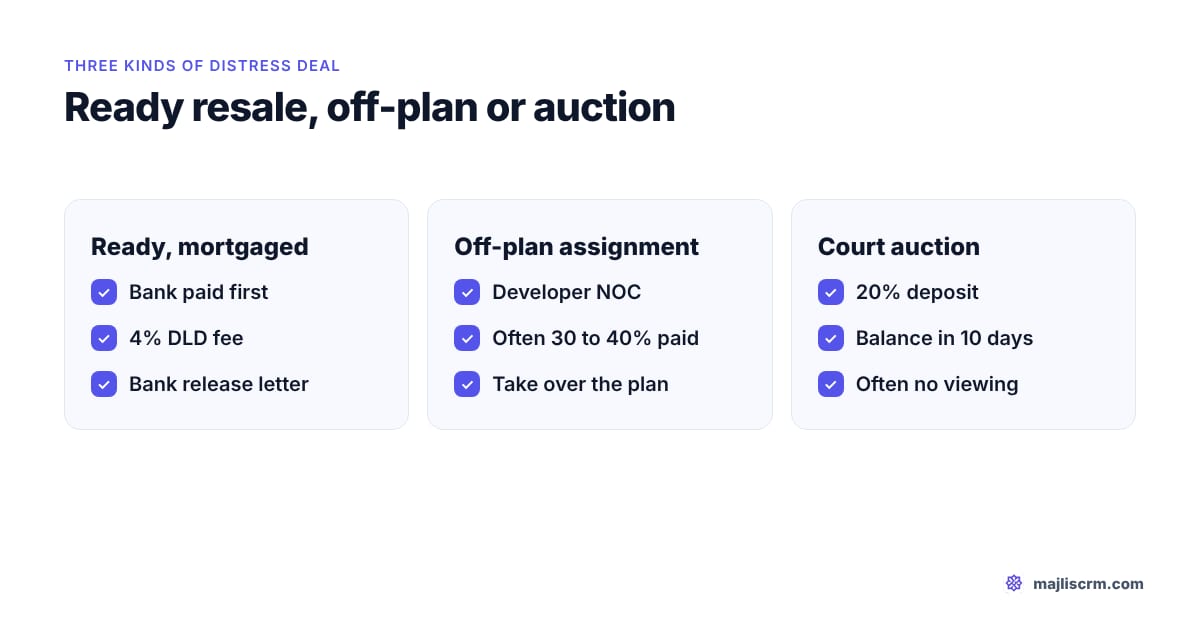
Emirates Auction runs property sales assigned by the judicial authorities. Its FAQ says a bidder deposits 20% of the property value by manager's cheque or bank transfer, pays the balance plus fees within 10 days of bid approval, and that the buyer does not pay the previous owner's service charges. Viewing is only possible when the property is vacant.
Rule: In a court auction you buy what is there, often without a viewing, and you need the full price in cash within days. Banks are not part of the auction process, so a buyer who needs a mortgage is usually the wrong buyer for an auction lot.
How do agents source distress leads legally in the UAE?
Cold calling owner lists is the classic way to find distress leads, and it is the one most likely to get a brokerage fined. Two sets of rules apply.
The telemarketing rules (Cabinet Resolutions 56 and 57 of 2024)
Since 27 August 2024, marketing calls in the UAE must follow Cabinet Resolution No. 56 of 2024, with penalties in Resolution No. 57. As summarised by Clyde and Co in July 2024:
- Marketing calls only between 9am and 6pm.
- No more than one call a day to the same person, and no more than two a week if they do not answer.
- No further calls once the person has said no.
- Calls from local numbers registered to the company's licence, never from an agent's personal number.
- No calls to numbers on the Do Not Call Registry (DNCR).
- Fines for calling DNCR numbers of AED 50,000 for a first violation, AED 75,000 for a second and AED 150,000 for a third, with possible suspension.
We cover the rules in full in cold calling rules for UAE real estate.
Personal data protection (Federal Decree-Law No. 45 of 2021)
The UAE's personal data protection law, in force since 2 January 2022, prohibits processing personal data without the owner's consent, apart from limited exceptions such as public interest or legal proceedings. A spreadsheet of owners' phone numbers bought from someone you do not know is a liability, not an asset. Ask where any list came from, keep a record of how each person agreed to be contacted, and remove people who ask.
Watch out: "Everyone uses these lists" is not a defence. Build your distress pipeline from people who came to you: portal enquiries, past clients, referrals, developers' resale desks, other brokers with a seller but no buyer, and owners who answered a "sell fast" ad aimed at their community.
How do you verify a distress price against DLD data?
This is the step that separates an agent from a listing reposter. The Dubai Land Department publishes registered transactions on its open data page. You can filter by date range, sales or mortgages, ready or off-plan, area, usage and property type, then see the amount, the transaction size and property size in square metres, rooms, the master project and the project, and download the result as CSV. Older years are on Digital Dubai's data portal. The same page also has rent, valuation, project, broker and developer data.
Do it in four steps:
- Pull comparables. Same project (ideally the same building), same number of rooms, similar size, ready or off-plan to match, from the last three to six months.
- Normalise by size. Work out price per square foot for each comparable. DLD records sizes in square metres (1 sq m is about 10.764 sq ft), and the registered size can differ from the size in a listing, so compare like with like.
- Take the median, not the best sale. One unusually high sale makes every listing look cheap.
- Measure the gap. A discount of a few percent is normal negotiation. A double-digit gap to the median of fresh comparables is worth calling a distress price, provided the checks in the next section come back clean.
Tip: Check whether a view, floor or upgrade explains the gap. A "distress" studio facing a wall is not a discount on the one facing the marina.
What should you check before buying a distress property in Dubai?
A low price often hides a cost. Use this checklist on every distress deal before money moves.
| Check | Where to verify | Red flag |
|---|---|---|
| Ownership | Title deed against the seller's Emirates ID or passport | Seller is not on the deed and has no power of attorney |
| Real discount | DLD open data transactions, same building and size, last 3 to 6 months | Discount only against the listing's "original price" |
| Mortgage | Bank liability letter with the amount owed | Amount owed is higher than the agreed price |
| Service charges | Developer or owners association, through the NOC | Arrears the seller cannot clear before transfer |
| Developer NOC | e-NOC from the developer via the Dubai REST app (required for freehold sales) | Developer refuses or delays the NOC |
| Off-plan payments | Developer statement of account; contract registered on the interim register | Missed instalments, or share paid below the developer's resale threshold |
| Tenancy | Registered tenancy contract and its end date | Sitting tenant on a long contract when the buyer wants to move in |
| Auction terms | The auction listing and conditions | No viewing, and buyer cannot fund 100% within 10 days |
Mortgage still on the property
DLD has a set procedure for registering the sale of a mortgaged property. The buyer and seller go to a Real Estate Registration Trustee centre with the bank's liability letter (or a letter from the developer stating what remains), and three manager's cheques: one to the bank or developer for the debt, one to the seller for the balance, and one to DLD for the 4% fee. The registration is completed after the seller gets the bank's mortgage release letter. That design protects the buyer: the bank is paid before the seller sees anything.
Service charges
Unpaid service charges are a common reason owners sell in a hurry. DLD's investor guide explains that the developer's NOC exists to confirm the seller has paid all service charges, so the NOC will not come while charges are outstanding, so they must be settled before transfer, usually out of the seller's proceeds. Agree in writing who pays them, and ask for the latest statement early.
Off-plan payment status and the developer NOC
Under Law No. 13 of 2008, every disposal of an off-plan unit must be registered on the Interim Real Estate Register, or it is void. In practice that means the developer must agree to the transfer. Most developers only issue a resale NOC once a minimum share of the price is paid. Dubizzle puts it at 30 to 40% depending on the contract and the developer. The exact figure is in the seller's sale and purchase agreement, so read that clause before you promise a buyer anything. NOC fees are set by each developer and are not published by DLD, so ask the developer for the figure in writing.
What does a distress deal look like in numbers? A worked AED example
The comparable prices below are illustrative. The fees are DLD's published figures, as of October 2026.
A seller in Dubai Marina is relocating in six weeks and still has a mortgage. The unit is a one-bedroom, about 800 sq ft. The seller owes the bank AED 900,000 and asks AED 1,300,000 for a quick sale.
Step 1: the comparables. DLD transactions for one-bedrooms of a similar size in the same building over the last six months show AED 1,420,000, 1,450,000, 1,480,000, 1,500,000 and 1,530,000. The median is AED 1,480,000.
Step 2: the discount. AED 1,480,000 minus 1,300,000 is AED 180,000, about 12% below the median. That qualifies as a distress price if the checks are clean.
Step 3: the cheques at the trustee centre.
| Item | Basis | AED |
|---|---|---|
| Manager's cheque to the bank | Amount on the liability letter | 900,000 |
| Manager's cheque to the seller | Price minus the debt | 400,000 |
| DLD registration fee | 4% of AED 1,300,000 | 52,000 |
| Trustee (registrar) fee | Price of AED 500,000 or more | 4,200 |
| Title deed | Fixed | 250 |
| Map (apartment) | Fixed | 250 |
| Knowledge and innovation fees | AED 10 each | 20 |
| Total for a cash buyer, before commission | 1,356,720 |
DLD's sale registration page lists the 4% as 2% for the seller and 2% for the buyer. Who actually pays is agreed in the sale contract; this example assumes the buyer pays the full 4%. The seller also pays the mortgage release charges: AED 1,290 for the release procedure and AED 315 for the registrar.
Step 4: the real saving. Buying at the AED 1,480,000 median would cost AED 59,200 in DLD fees plus the same AED 4,720 in fixed fees, AED 1,543,920 in all. The distress deal saves the buyer about AED 187,200 before commission, as long as the service charge statement is clean and the developer issues the NOC.
The off-plan version
Now take an off-plan one-bedroom in JVC bought at AED 900,000. The owner has paid 40% (AED 360,000) and cannot fund the next instalments. The remaining AED 540,000 is still owed to the developer on the payment plan.
- The seller accepts AED 870,000, AED 30,000 below what they agreed to pay.
- The buyer pays the seller AED 330,000 (AED 870,000 minus the AED 540,000 still owed) and takes over the payment plan.
- DLD's fee is 4% of AED 870,000, which is AED 34,800, split as the parties agree.
- The developer's NOC fee comes on top and varies by developer.
The buyer's question is not "is it below launch price?" but "is AED 870,000 below recent sales of similar units in this project, and can I fund the remaining AED 540,000 on the developer's dates?"
What are the risks of distress deals in Dubai?
- The discount is fake. Priced against an inflated "original price" or a launch price, not against recent sales.
- Debt above price. If the seller owes more than the price, they must fund the gap before the bank releases the mortgage.
- Service charge arrears that block the NOC and delay transfer.
- Off-plan exposure. Missed instalments, penalties in the contract, a resale threshold not yet reached, or a delayed project.
- No viewing at auction, plus a full payment deadline that rules out finance.
- Financing gaps. Banks lend against their own valuation, which can come in below the agreed price, and approval takes time. A buyer without mortgage pre-approval can lose a fast deal, so check finance before you make the offer.
- Seller changes mind. A motivated seller with a better offer can withdraw before signing, so get a signed agreement early.
Investors new to Dubai should read how to invest in Dubai property before chasing distress prices, and sellers abroad will find the transfer steps in selling property in Dubai from abroad.
How do you work distress leads in a CRM?
Distress deals reward the agent who already knows the buyer. A unit 12% under the building median draws offers within hours, so the work happens before the lead arrives.
1. Keep a buyer list that is ready to act
Tag buyers who have told you they want below-market opportunities, and record what they can do: cash or mortgage, pre-approval amount, communities, budget and how fast they can move. A buyer who "might be interested" is not on this list. When a distress lead lands, you should be able to name three people who can pay within days.
2. Tag and stage every distress lead
Give distress sellers their own tag and their own pipeline stages: "Price verified", "Mortgage and NOC checked", "Offered to buyers", "Agreed". Make a stage refuse to move until the verification note is written, and keep the DLD comparables, liability letter and service charge statement on the lead, so you answer buyers with evidence.
3. Answer in minutes, not hours
Motivated sellers call several agents, and the first credible callback usually wins the listing. Time your response.
4. Share off-market, then list properly
Many distress sellers prefer a quiet sale. Send the deal to your ready buyers first. If you advertise it on the portals, the listing needs a DLD advertising permit like any other, as explained in our permit guide.
In Majlis CRM, enquiries from Property Finder, Bayut and Dubizzle, WhatsApp, lead ads and your website land in one pipeline, and pipeline stages can require fields or a note before a lead moves on, which is how you enforce the "price verified" step. Lead rotation passes a lead nobody contacts in time to the next agent, and response-time tracking shows who is fast. A distress unit can go out first as a pocket listing shared by link, and your buyer list can be messaged through WhatsApp templates on Meta's official API. See how it works in lead management and WhatsApp CRM.
If your team works distress deals and wants one place for sellers, buyers and the evidence behind each price, book a demo. Every feature is in every plan, with a 14-day free trial.
Frequently asked questions
What does "distress deal" mean in Dubai?
It means a property offered below recent market value because the seller needs to sell quickly, for example to clear a mortgage, avoid an off-plan instalment or relocate. It is a market term, not a legal category, so each claim has to be checked against DLD transaction data.
Are distress deals in Dubai real in 2026?
Some are. Transactions fell 31% year on year in Q2 2026 and average values dropped about 7% per sq ft, according to Betterhomes data reported by Khaleej Times in July 2026, which brings out more motivated sellers. The same report found no panic selling, so many "distress" listings are simply priced at market.
How can I check if a distress price is genuine?
Pull DLD's registered sales for the same project, room count and similar size from the last three to six months, and compare price per square foot with the median. A double-digit discount to fresh comparables, with clean mortgage, NOC and service charge checks, is a genuine distress price.
Can I buy a property in Dubai that still has a mortgage?
Yes. DLD's mortgaged sale procedure has the buyer pay the bank's outstanding amount by manager's cheque, the seller the balance, and DLD the 4% fee, at a trustee centre. Ownership is completed once the bank issues the mortgage release letter.
Can I resell an off-plan property in Dubai before handover?
Usually, with the developer's NOC. Most developers require a minimum share of the price to be paid first, commonly 30 to 40%, as set in the sale and purchase agreement, and the transfer must be registered on the interim register under Law No. 13 of 2008.
Is it legal to cold call owners for distress leads in the UAE?
Marketing calls are allowed under Cabinet Resolution No. 56 of 2024 only from a company-registered number, between 9am and 6pm, and never to numbers on the Do Not Call Registry. Calling a DNCR number can cost a company AED 50,000 to 150,000, and personal data needs the owner's consent under Federal Decree-Law No. 45 of 2021.
How do Dubai property auctions work?
Court-ordered sales are run as public auctions, often online through Emirates Auction. Bidders deposit 20% of the value, the winner pays the balance and fees within 10 days, and the property is sold as it stands, often without a viewing.
This is general information, not legal, financial or investment advice. Fees, rules and developer policies change; confirm current requirements with the Dubai Land Department, the developer and a qualified adviser before you buy or sell.
Sources
- Registering the Sale of a Mortgaged Property, Dubai Land Department, accessed October 2026.
- Sale registration application, Dubai Land Department, accessed October 2026.
- Real estate open data: transactions, Dubai Land Department, accessed October 2026.
- Dubai property market sees no immediate impact from renewed regional tensions, says Betterhomes, Khaleej Times, 16 July 2026.
- Dubai mortgages: When can banks repossess homes for missed loan payments?, Khaleej Times, 12 July 2026.
- The process of selling a mortgaged property through a court-supervised auction in Dubai, BSA Law, 18 September 2024.
- Property auctions FAQ, Emirates Auction, accessed October 2026.
- UAE tightens telemarketing regulations: what you need to know, Clyde and Co, 18 July 2024.
- Data protection laws, u.ae, accessed October 2026.
- When can you sell an off-plan project in Dubai, Dubizzle, accessed October 2026.
- Know Your Rights: For Real Estate Investors in Dubai, Dubai Land Department (guide covering Law No. 13 of 2008 and the developer NOC), accessed October 2026.