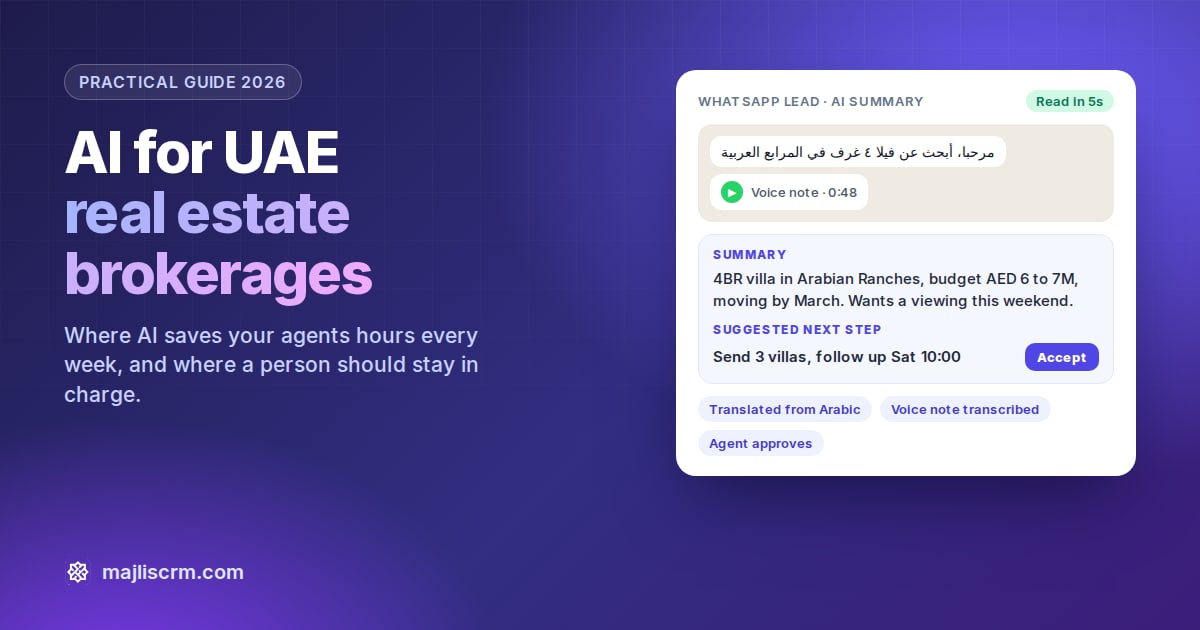
Quick answer: UAE real estate brokerages save the most with AI by handing it the reading and typing: summarising WhatsApp chats, turning call notes into records, translating, drafting replies and analysing market data against their own leads. Keep people in charge of anything sent to a client, measure the hours saved, and protect client data under the UAE PDPL.
Key takeaways
Most of an agent's admin is reading and typing. That is exactly the work today's AI does well.
Start by timing one agent's day. The tasks that eat the most minutes are where AI pays off first.
Let AI draft and suggest, and let agents approve and send. A wrong message to a client costs more than the time it saved.
Public Dubai Land Department data, analysed in Claude or ChatGPT and compared with your own CRM, shows which clients to call about which areas.
Client names, numbers and documents are personal data. Choose tools that keep them inside your systems.
Every brokerage owner in Dubai has heard that AI for real estate brokerages in the UAE will change everything. In practice, the gains are less dramatic and more useful: fewer hours spent scrolling chats, typing notes and translating messages, and fewer leads forgotten in between. This guide covers where AI genuinely saves time and money, what to leave to people, and a simple 30-day plan to try it without disrupting your team.
Where does an agent's time actually go?
Before buying anything, look at a normal day. A busy Dubai agent might handle 20 to 40 WhatsApp conversations, a dozen calls, a few viewings and a stack of portal leads. The selling part, meeting people and negotiating, is a small share of the day. The rest is admin:
Scrolling back through long chats to remember what a client wanted.
Writing up calls in the CRM, or not writing them up at all.
Translating Arabic, Russian or Hindi messages with a separate app.
Typing the same replies about availability, service charges and viewing times.
Gathering numbers for the weekly sales meeting.
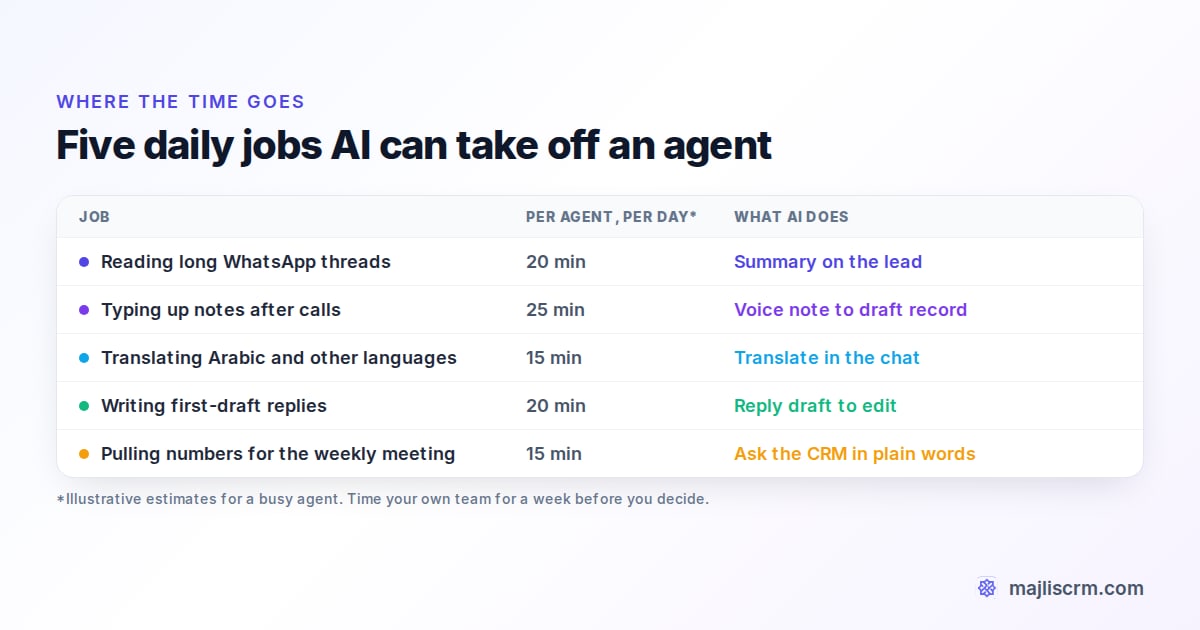
The figures above are illustrative, but the pattern holds in most brokerages: well over an hour a day per agent goes on reading and typing. That is the work current AI tools handle reliably, which makes it the right place to start.
How can AI save a brokerage money?
AI rarely replaces an agent. It saves money in three quieter ways:
Hours back for selling. If AI halves the admin above, a 10-agent team gets back roughly 45 minutes per agent per working day. Over a month that is around 160 hours, the equivalent of a full-time agent's time, spent on calls and viewings instead of typing.
Fewer lost leads. Leads go cold when nobody remembers to follow up. A suggested next step on every conversation means fewer forgotten buyers, and each recovered deal is worth far more than the tool.
Less dependence on one person. When a lead's history is summarised in the CRM, a manager or a new agent can pick it up in seconds. Agent turnover costs less when the knowledge stays with the brokerage.
Do the sum for your own team before you commit. Multiply the minutes saved per agent by the number of agents and working days, then compare that with what the tools cost.
10 practical ways UAE brokerages can use AI
1. Summarise every WhatsApp conversation
Long WhatsApp threads with voice notes, photos and mixed languages are the hardest thing in a brokerage to hand over. A good AI summary turns a 200-message chat into four lines: what the client wants, their budget and area, what has been sent and what is still open.
How to do it well: keep the summary on the lead record, not in a separate tool, so everyone sees the same version. Ask for facts (budget, area, timeline, objections), not opinions about the client.
In Majlis CRM: the AI assistant reads each lead's WhatsApp conversation, including voice notes, and writes a short summary on the lead. It can also fill in blank lead details it finds in the chat, such as budget or preferred area, and never overwrites anything an agent typed. Every change it makes is logged and can be undone for 24 hours.
2. Let AI suggest the next step, and let the agent decide
The most expensive moment in real estate is the follow-up nobody sent. AI is good at reading a conversation and proposing what should happen next: "Send three villas in Arabian Ranches and follow up on Saturday at 10:00."
The important word is suggest. An entry on an agent's calendar is a commitment, and the agent knows whether it is worth making. Tools that create tasks and meetings on their own quickly fill calendars with noise that people learn to ignore.
In Majlis CRM: follow-ups and appointments from a chat are offered as suggestions. The agent accepts one with a click and it lands on their calendar, with a reminder when it comes due.
3. Turn calls and voice notes into records
Most agents do not write up calls because typing on a phone between viewings is painful. Speaking is easy. A 30-second voice note after a call ("Spoke to Ahmed, wants a 3-bed in JVC under 2 million, call him Thursday") holds everything the CRM needs.
AI can transcribe that note, pull out the name, budget, area and follow-up date, and prepare the record for the agent to check. If you record calls themselves, a transcript and summary make them searchable later. Under UAE telemarketing rules, tell the other person a call is being recorded; our guide to cold calling rules in the UAE covers the rest.
In Majlis CRM: the microphone button turns a spoken note into draft cards: a new contact and lead, a stage move, updated details or a follow-up. Agents can speak in English, Arabic, Hindi, Urdu or Malayalam, and the record comes out in English. Nothing is saved until the agent reviews it. Logged calls can also be recorded, transcribed and summarised on the lead.
4. Close the language gap
Dubai buyers write in Arabic, English, Russian, Hindi, Chinese and more. Copying messages into a translation app and back wastes minutes per message and loses context.
Translation inside the chat is one of the clearest wins in this list. The agent reads every message in their own language and replies in the client's. Still read back anything important, such as a price or a payment term, because a mistranslated number is costly.
In Majlis CRM: agents can translate an incoming WhatsApp message into their language, or write a reply in English and translate it into the client's language before sending.
5. Draft replies, but never auto-send them
Many client questions repeat: is it still available, what are the service charges, can I view on Saturday. AI can draft these replies in seconds, in the tone of the conversation.
Keep a person between the draft and the client. A reply that confidently states the wrong price or promises a unit that has gone causes real damage, and in a regulated market it can cause a complaint. Draft, check, then send.
In Majlis CRM: reply drafts appear in the chat for the agent to edit and send. The AI never sends a WhatsApp message on its own.
6. Give the AI your own facts
A general AI tool does not know your service charges, your viewing policy or which developer pays commission on which project. Without that, it guesses, and guesses sound convincing.
Write down the facts your agents repeat most often: office hours, viewing rules, documents a tenant needs, the payment plan on your main off-plan projects. Keep each entry short and dated, and review them monthly. Treat them as reference for the AI, not instructions it must follow blindly.
In Majlis CRM: a brokerage's own knowledge base feeds the WhatsApp AI, so summaries and reply drafts draw on your facts. Anything the knowledge base does not cover, the AI is told not to invent.
7. Match new listings to buyers you already have
The fastest sale is often to someone already in your database. When a new listing comes in, someone should ask: who asked for this area, this size, at this budget? In most brokerages nobody has time to check.
This does not even need AI. A simple comparison of budget, community and size across your open leads finds the obvious matches. What matters is that it runs every time a listing is added.
In Majlis CRM: property matching compares each listing with your open leads on budget, community and size, and ranks the best fits so the agent can send it to the right buyers first.
8. Ask your CRM questions in plain language
Weekly meetings often start with someone exporting spreadsheets. Assistants such as Claude and ChatGPT can now connect to business tools through MCP connectors and answer questions from live data: "Which leads with a budget over AED 5M have gone quiet for 10 days?"
Connect each person with their own login, so the AI sees only what that person could see anyway, and start with read-only access. Our guide on connecting a real estate CRM to Claude or ChatGPT walks through the setup.
In Majlis CRM: the MCP connector works with Claude and ChatGPT. It is read-only and follows each person's permissions, and a founder can revoke any connection in one click.
9. Use general AI tools for marketing and training
Outside the CRM, general assistants are useful for work that involves no client data:
Listing descriptions: give the AI the facts (size, view, floor, amenities) and ask for a first draft. Check every claim, and never let it add amenities the unit does not have. Make sure the ad carries the permit details your emirate requires.
Social posts and newsletters: draft a week of posts about a community in one sitting, then edit them in your own voice.
Market notes: summarise a long developer brochure or a public market report into a one-page brief for the team.
Training: ask the AI to play a difficult buyer so new agents can practise handling objections about price, service charges or handover dates.
10. Analyse market data and match it to your clients
This is where AI goes from saving time to making money. Dubai publishes more property data than most markets in the world, and very few brokerages use it beyond quoting a headline figure. An AI assistant can turn a raw spreadsheet of transactions into a clear view of where prices are moving, and then tell you which of your own clients that matters to.
Where to get the data
| Source | What you get | Cost |
|---|---|---|
| Dubai Land Department open data | Official sales, mortgage and gift transactions, rental contracts, projects, valuations, buildings and brokers, filtered by date and area and downloadable as CSV | Free |
| DXBinteract | Dashboards built on DLD data: transaction volumes, prices per square foot, rents and off-plan activity by community | Free |
| Dubai REST app | DLD's official app, with recent transactions and rental index figures by area | Free |
| Abu Dhabi Real Estate Centre (ADREC) data portal | Official Abu Dhabi transactions, residential leases and price trends | Free |
| Your own CRM | Enquiries by area and budget, lost reasons and how fast leads convert | Already yours |
Step 1: analyse the market. Download the last 12 months of sales for the communities you cover from the DLD portal and upload the CSV to ChatGPT or Claude. Both can read a spreadsheet, run the calculations and draw charts. Then ask questions like:
"Show the median price per square foot for 2-bedroom apartments in JVC, month by month, and the change over 12 months."
"Which five communities had the biggest rise in transaction volume this quarter compared with last?"
"Compare off-plan and ready sales in Dubai Hills Estate: share of volume and median price."
"Which areas have villas selling between AED 3M and 4M, and how many sold last quarter?"
Check the work before you share it. Ask the AI which columns it used and how it filtered the data, compare a headline figure with DXBinteract, and keep sales, mortgages and gifts apart, because mixing them distorts prices. Public transaction data holds no client details, so it is safe to upload.
Step 2: match the trends to your clients. Market data on its own is a report. Combined with your CRM it becomes a call list. Connect your CRM to the same assistant with a read-only connector, keep the market analysis in the conversation, and ask:
"Using the JVC prices from this analysis, which of my open leads want a 2-bed in JVC with a budget that still fits? Which have been priced out?"
"For leads looking in Dubai Marina whose budget is now below the market median, suggest two nearby communities where their budget buys the same size."
"Which of my investor leads asked about off-plan, and which communities from this analysis had the strongest off-plan growth?"
"Draft a short WhatsApp note for each matched lead explaining what changed in their area. Don't send anything."
A Monday routine like this takes 20 minutes and gives every agent a reason to call a client that is about the client's own search, not a generic "any update?" message. It also catches buyers who were priced out of their first-choice area before they give up and go quiet.
In Majlis CRM: the MCP connector lets Claude or ChatGPT search your leads by preferred area, property type and budget, alongside the market data you uploaded. It is read-only, each person sees only the leads their role allows, and nothing is sent to clients. The client data stays in Majlis: the assistant looks it up through the connector instead of you exporting a list.
How do you keep client data safe when using AI?
Client names, phone numbers, budgets and Emirates IDs are personal data under the UAE's Personal Data Protection Law (Federal Decree-Law No. 45 of 2021). Free-zone brokerages may also fall under DIFC or ADGM rules. A few habits cover most of the risk:
Prefer AI built into your tools. AI inside your CRM works on data that is already there, under your vendor's data agreement. Pasting chats into a personal chatbot account copies client data somewhere nobody controls.
Use business plans. If staff use general assistants, give them business accounts, where the providers state they do not train on your data by default.
No documents in chatbots. Passports, Emirates IDs, title deeds and bank details should never be pasted into a general AI tool.
Write a one-page AI policy. Which tools are approved, what data can go into them, and who checks AI output before it reaches a client.
Keep an audit trail. You should be able to see what the AI changed and undo it.
A 30-day plan to roll out AI in your brokerage
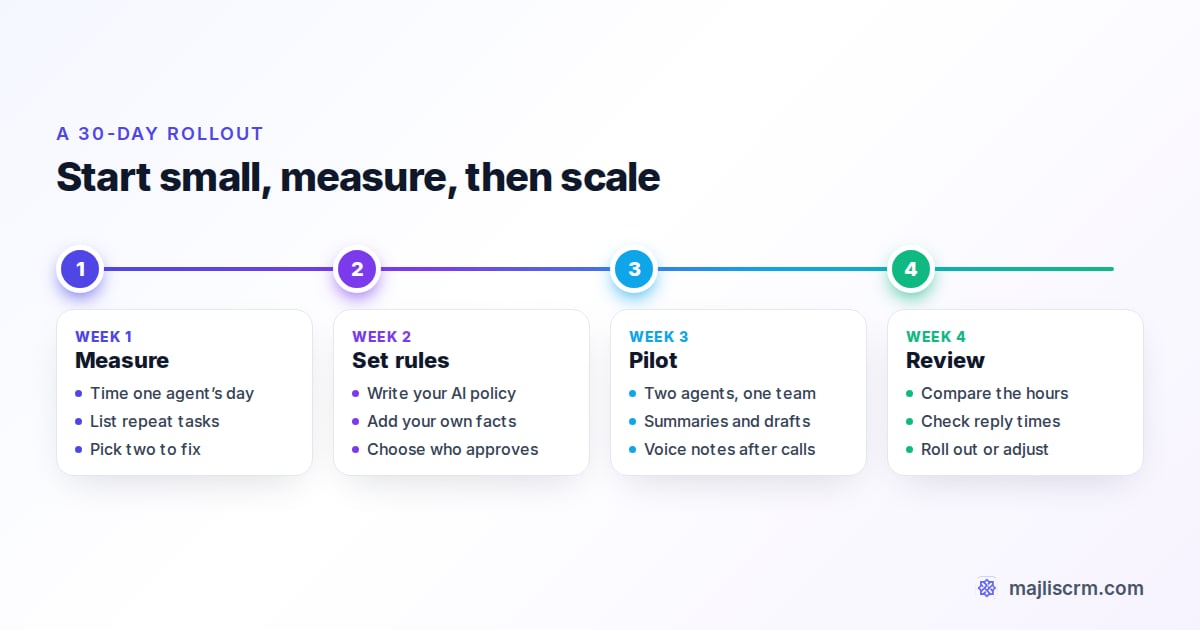
Rolling AI out to the whole team on day one usually fails: people try it, hit one bad result and stop. A short, measured pilot works better.
Week 1, measure. Time one or two agents for a full week. Note how long they spend reading chats, writing notes, translating and replying. Pick the two biggest time sinks.
Week 2, set rules. Write your one-page AI policy, add your most-repeated facts to the knowledge base, and decide who approves AI drafts.
Week 3, pilot. Turn on summaries, reply drafts and voice notes for two agents on one team. Ask them to flag every wrong or unhelpful result.
Week 4, review. Compare their admin time and response times with week 1. If the numbers moved, roll out to the next team. If not, adjust and try again.
The measurement matters more than the tool. "It feels faster" does not survive a budget review; "our agents reply to portal leads 12 minutes sooner and log twice as many calls" does. Faster replies also help with portal programmes such as Property Finder SuperAgent and Bayut TruBroker, which our response-rate guide covers in detail.
Frequently asked questions
Will AI replace real estate agents in the UAE?
Not in any way that matters to a brokerage today. Buyers and landlords still want a person to advise them, show them units and negotiate for them. What AI replaces is the admin around that work: reading, typing, translating and reporting.
What is the easiest AI tool for a brokerage to start with?
Chat summaries and translation, because they save time immediately and never send anything to a client. Voice notes after calls are a close second, since they get records into the CRM that would otherwise never be written.
Is it legal to use AI with client data in the UAE?
Yes, if you handle the data as the UAE PDPL and any applicable free-zone rules require: for a clear purpose, kept secure, and shared only with providers you trust. Using AI that is built into your CRM, rather than copying chats into personal chatbot accounts, keeps that much simpler. Take legal advice for your specific setup.
How much time can AI save a real estate agent?
It depends on how much of the day is admin. For a busy agent handling many WhatsApp conversations, halving the reading, note-taking and translation can free 30 to 60 minutes a day. Time your own team for a week to get a real figure.
Should AI reply to leads automatically?
Use approved templates for instant first replies to new leads, so nobody waits. After that, let AI draft and let the agent send. Automated replies that state prices or availability without a check are the fastest way to lose a client's trust.
Start with the work nobody likes
The brokerages getting real value from AI are not the ones with the most tools. They picked the dullest, most repeated work, handed it to AI, kept people in charge of what reaches clients, and measured the result. Start there, and the savings are easy to see.
If you want to see these features working on your own leads, explore the Majlis CRM AI assistant or book a demo for your brokerage.